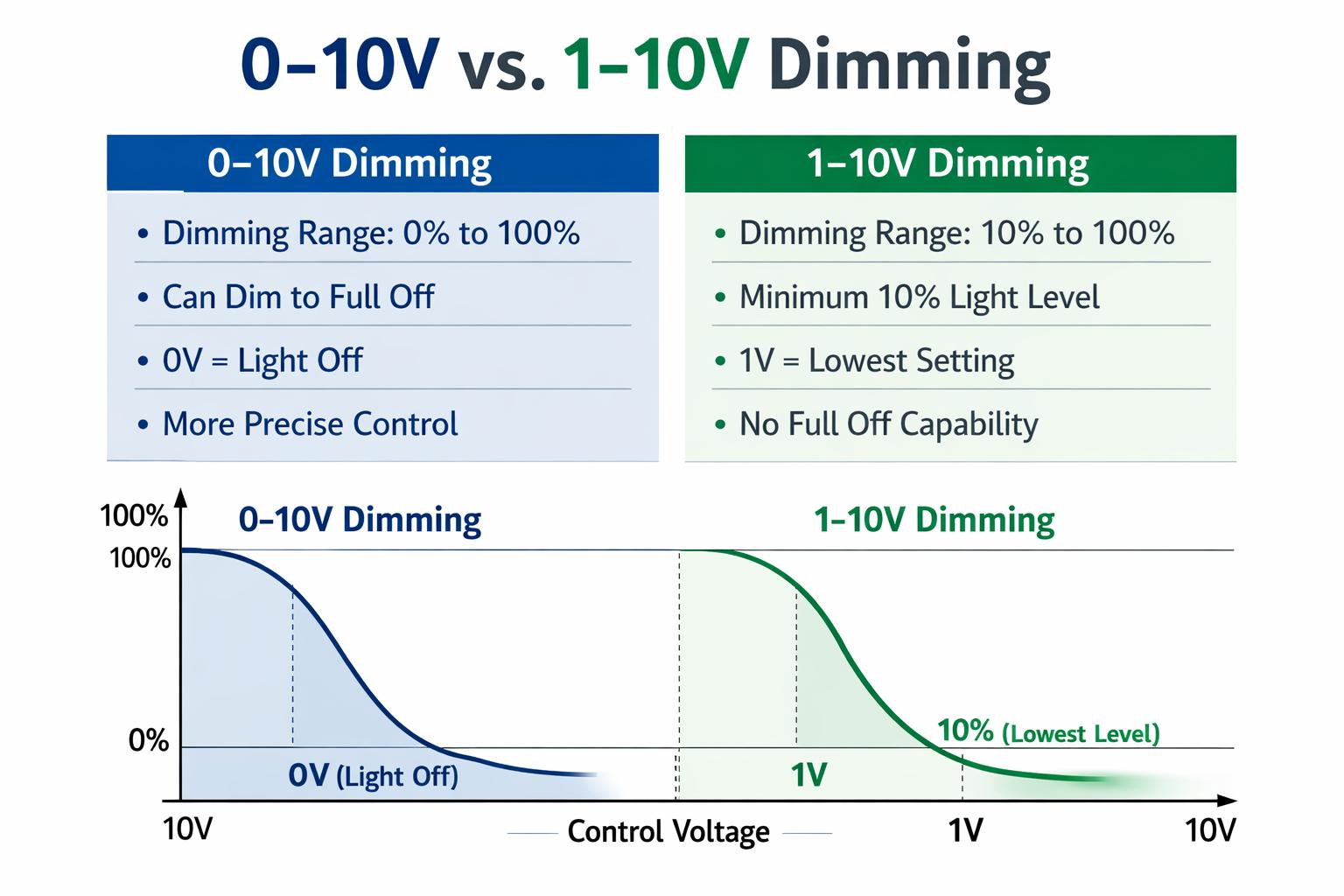
0–10V vs 1–10V: The Story Behind Two Dimming Cultures
Where 0–10V and 1–10V Originally Came From
The origins of 0–10V and 1–10V dimming are completely different. 1–10V was developed in Europe during the fluorescent ballast era under IEC 60929. Fluorescent lamps could not dim near 0%, or the arc would extinguish and damage the lamp, so the standard required a minimum of 1V. This produced a dimming method that “cannot go completely dark.”
In contrast, 0–10V emerged from North American stage and architectural lighting, where deep dimming was fundamental. These systems naturally used 0V as “off” and 10V as “full brightness,” which later evolved into the ANSI C82 standard widely adopted in commercial lighting.
How Different Histories Shaped Different Markets
Europe embraced 1–10V because dimmable fluorescent lighting was common in offices, forming an ecosystem that later shifted toward DALI and D4i. North America, however, never relied on dimmable fluorescent lamps. Their dimming culture grew from stage lighting and major control brands like Lutron and Leviton, making 0–10V the mainstream choice—simple, low-cost, and ideal for occupancy sensors and automation.
The Core Technical Difference and Future Trends
Technically, 1–10V is a passive current-sink system, where fixtures generate 10V and dimmers pull the voltage down to a minimum of 1V. 0–10V is an active current-source system, where the dimmer outputs 0–10V directly, enabling true 0% dimming and the ability to switch off lights via the control signal.
Looking ahead, DALI-2, D4i, and wireless protocols will continue expanding. Yet analog dimming—especially 0–10V in North America—will remain strong due to large installed bases and cost-sensitive projects.